Case Study 1:
#Generative
#Mixed-Methods
When I joined RentSpree as a Senior UX Researcher, I was asked to run a 6-month Voice of the Customer program. Unlike most research projects at RentSpree, this project was initiated by the C suite team. Their goal: "give the greater team access to our users." Essentially, employees had questions about our users that my new research team had yet to address. Leadership tasked me with designing and executing the program to achieve this goal.
One unusual aspect of this project: leadership had recruited the participants prior to my joining! Moreover, these participants didn’t represent our general user base. They were power users. They used our product a lot more than others and, from what my desk research taught me, were far more successful in their careers than the average real estate agent. Whatever I learned about this small sample of atypical users wouldn’t necessarily apply to our general user base. So, I needed to adapt.
No problem!
Yes, I’m a PhD trained researcher who was an influential scholar in mindfulness research, but I also led a UX research program at an early startup with a tiny budget. So, “scrappy” is my middle name. I saw this as an opportunity to learn from an unconventional but highly impactful group of users. After all, once I learned how these power users “hacked” their jobs to be done, maybe we could adapt our product to teach their strategies to others.


As a researcher, my first step is always to “align and design.”
Research is a team game. I find that my research output has the greatest impact when I involve my cross-functional team in the process as early as possible. I'm the researcher, but framing it as “our research” has been very effective.
For this 6-month program, I started by asking the C suite team some clarifying questions about their goals. Then, I conducted desk research to see what info was already available to answer my questions. This helped me determine which methods and focus would be most valuable.
For a normal research project, I lead my immediate cross-functional team in ideating on key research goals, share a draft of the research plan in a large Slack channel, and ask my team and the VP of Product to provide feedback or a thumbs up.
However, this project was different. The number of stakeholders was vast and it included the whole C suite team. So, I created a study plan in Notion and shared it with the leadership team and my manager. Once aligned, I invited the entire company to share questions they had about our users and their reasons for wanting answers in a Notion table. This helped me understand the business stakes of various questions, allowing me to determine priorities and create coherent themes for monthly program activities.

I took a close look at the research participants even before I aligned with the team or created materials. From their online presences, I could tell that something was different about these participants.
Our platform offered a variety of workflow tools to support real estate agents, landlords, and renters in the property rental process. The platform had been designed with real estate agents as the core user, since they bring other types of users into our system. In fact, the platform was designed around a single use case: agents who are trying to support their landlord clients in renting out their properties.
Yet, the power users that leadership had recruited seemed to represent renters, not landlords. Their job was to help renters find a place to live. So, I did some desk research to learn about this “renter’s agent” use case. I also asked team members about this use case and only a few had heard of it.
I would address this massive company-wide knowledge gap!
Since these agents were unusually successful and few in number, I decided to design a robust survey to send to a large group of agents from our broader user base to learn about this use case from a representative sample. The goal was to develop a deep understanding of the "renter's agent" use case: eg, their jobs to be done, typical behaviors, and ways of using our product. The output would be a research report and a user journey map. I was determined to turn leadership’s accidental recruitment of these atypical users into an opportunity.
I believed that collaboration could help in focusing the complementary survey. Collaborating with your cross-functional team isn't only about alignment and evangelizing, it's also about synthesizing our individual experiences into collective wisdom. This is invaluable when formulating hypotheses.
Most of my colleagues had no idea what a renter's agent was, but a few were somewhat familiar--namely, sales people who had previously been agents or worked at brokerages and customer service reps who had handled thousands of phone calls from agents. Sometimes, agents would call about this use case. So, I recruited this select group of colleagues to mine their knowledge and shape this survey.
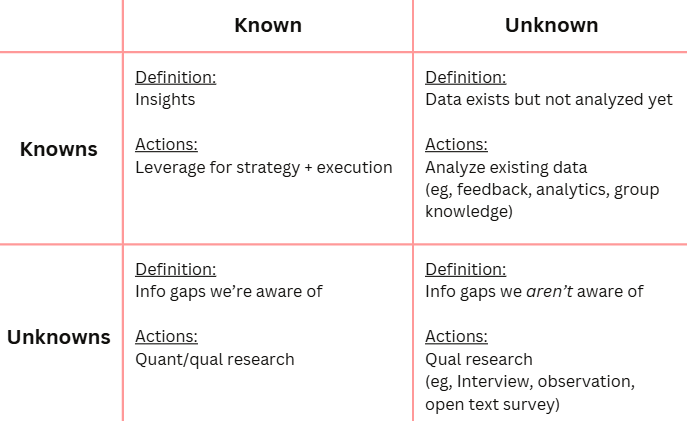
In our first group mapping session, I led the team in distilling their knowledge to identify the jobs to be done for renter's agents, creating the beginnings of a user journey map. Then, I revealed a different journey map, one that I had created based on desk research. We evaluated it together and started to synthesize the two maps. Afterwards, I went off on my own and completed the synthesis. Our second session was dedicated to identifying "high," "medium," and "low" confidence areas of the journey map. Which aspects of the journey did we feel least confident about? I would design the survey to dig into those low and medium confidence areas.
Not only did these collaboration sessions result in better research insights, but involving the mapping team in the research process–something that rarely happened with sales and customer service reps–got them invested in the research output and made them enthusiastic evangelists.

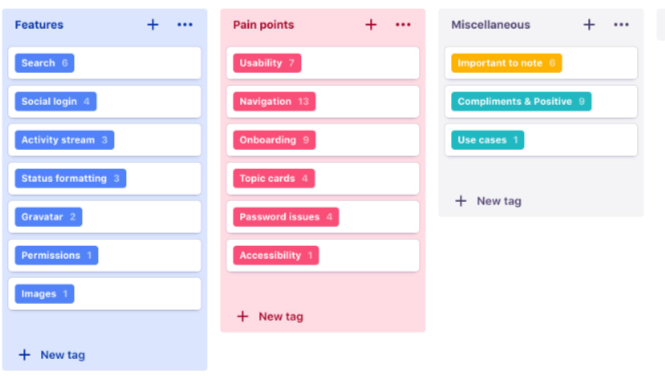
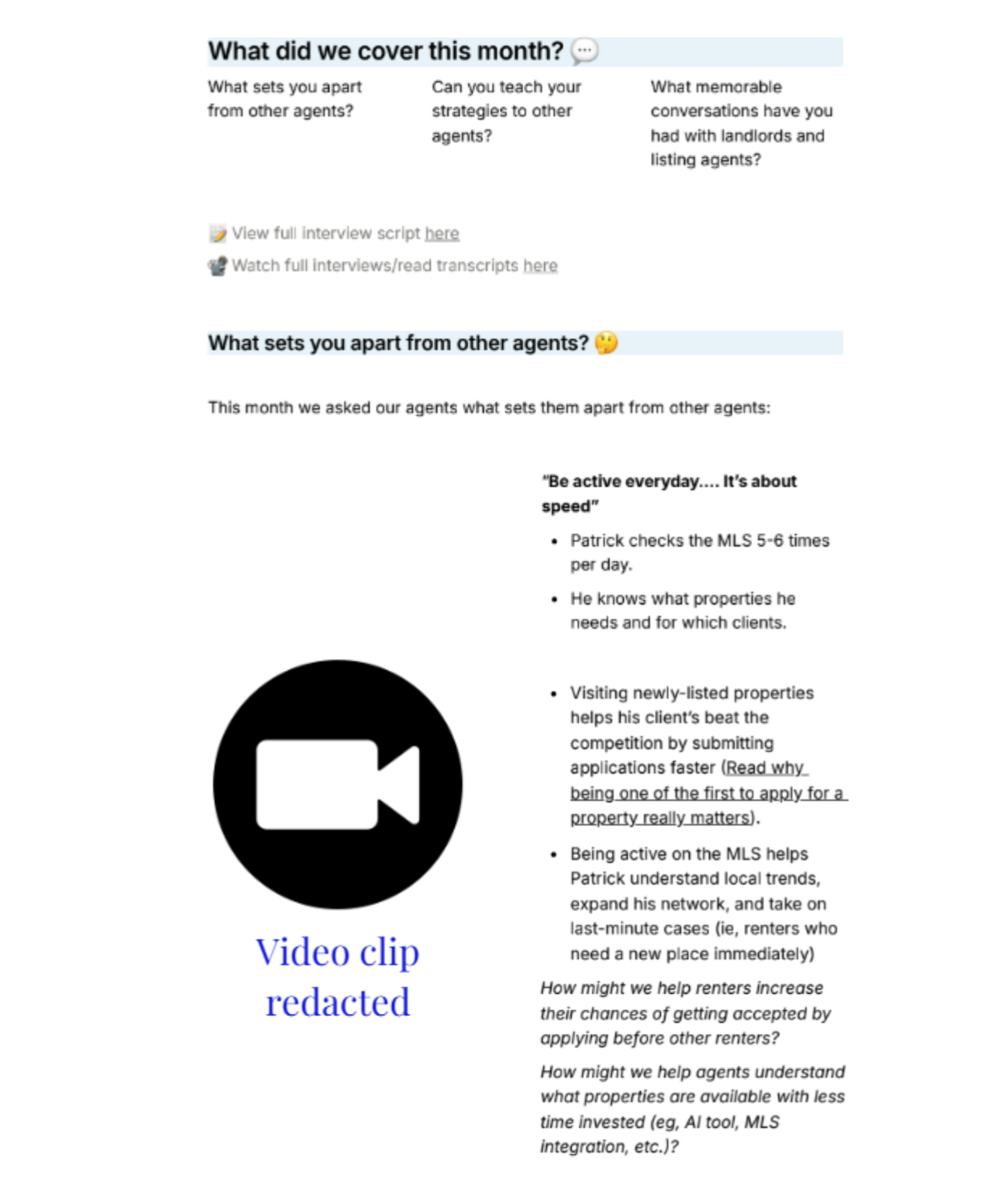
Monthly Newsletters
Survey Report
User Journey Map
Journey Map Supplement
Mid-Project Report
Program Impact Survey
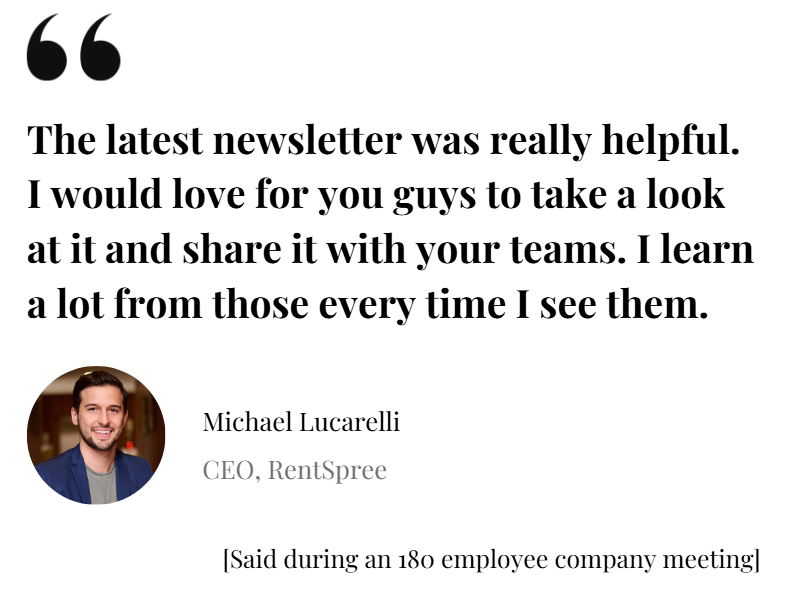
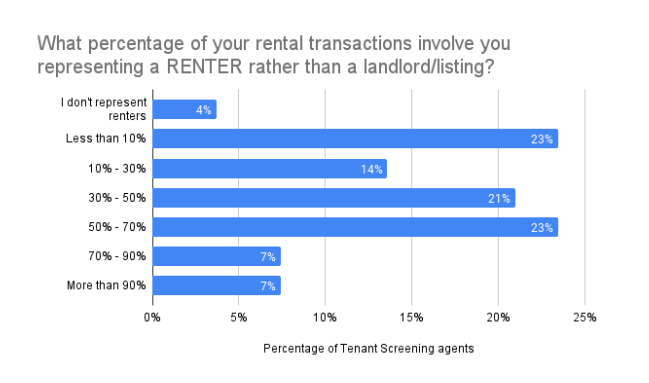
Running this program enabled me to increase our company’s knowledge base in a variety of ways. Of course, I uncovered a critical use case that was largely unfamiliar to employees–a use case accounting for 25% of all product use!–illustrating it in vivid detail. This made me the company expert on “renter’s agent” use cases and team members often approached me to ask questions about it. More importantly, after pointing out the need to accommodate renter’s agent use cases in product ideation and design feedback sessions and explaining how, others started doing it, too! My renter’s agent journey map became a common reference material. Designers and product managers started to remind each other about it and design toward this use case. The team was forever transformed.
Speaking with power users also taught us the numerous ways they “hack” our product to complete their jobs to be done more efficiently. This included entering fake rental properties into our system to fill in forms faster. This fake data uncovered flaws
in the regional heatmap of RentSpree-powered properties that I had co-created with a data product manager. Fake properties meant less assurance of which cities used our product the most.Luckily, we were in the process of allowing real estate agents to screen tenants without entering a property into our system. Therefore, these power users “hacking” our platform to meet their needs actually validated a major product roadmap item.